The films made the Infinity Stones famous and, in doing so, made them smaller. On screen they are six batteries. In the comics they are the residue of a being that predates the universe, they have personalities, they have been reorganised at least three times, and they sit inside a ranked cosmic bureaucracy that goes several levels above anyone who has ever held them.
This is the deep version: what each Gem does at full strength, who the abstract entities above them are, and why 'omnipotence' in Marvel is always conditional.
They are Gems, and they are the corpse of a god
In the comics the Stones are called the Infinity Gems, and their origin is a genuinely bleak piece of cosmology: they are the remains of a single omnipotent entity that existed before this universe and destroyed itself out of loneliness, its power fragmenting into six singularities.
That origin matters because it sets the ceiling. Six Gems together do not make you a god — they reassemble one. Whoever holds all six is running someone else's power, and the stories consistently punish anyone who mistakes the two.
Each Gem also governs one axis of reality: Mind, Soul, Space, Time, Power and Reality. Held individually they are potent but bounded; combined, their effects multiply rather than add, which is the whole design.
- FactIn Marvel comics the six Infinity Gems are Mind, Soul, Space, Time, Power and Reality, and are described as fragments of a single pre-universal entity.Source: Wikipedia
The Soul Gem is the strange one
Of the six, the Soul Gem has the most disturbing lore. It contains a pocket dimension — Soul World — where the souls it claims continue to exist, and it is repeatedly written as having a will and an appetite of its own. Adam Warlock's entire arc is a man bonded to a Gem that is hungry.
The films flattened this into a trade: a soul for a stone. In print it is closer to possession. Characters who use the Soul Gem casually tend to lose the argument about who is using whom.
That is why Soul is often ranked as the most dangerous Gem to hold despite the Power Gem being the raw-force one. Power kills you quickly; Soul keeps you.
Thanos never actually wins
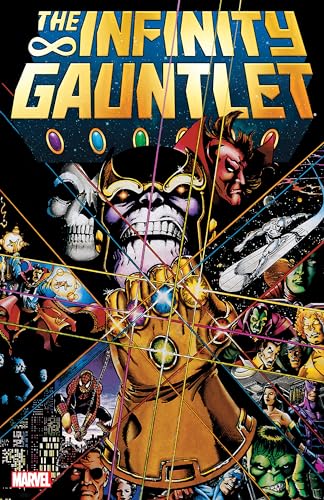
The Infinity Gauntlet (1991), by Jim Starlin and George Pérez, is the source text and it is not the story most film fans expect. Thanos does not want balance; he wants to impress Death, who is a literal character and who ignores him. He erases half of all life as a courtship gesture.
He also loses to himself. The recurring reading of the story — supported by the text — is that Thanos subconsciously engineers his own defeat because he cannot accept being supreme. That is a far weirder and better character than the film's utilitarian.
Mechanically, the story is also honest about the hierarchy. Even fully gauntleted, Thanos has to contend with the abstract entities, and he is only truly stopped once he steps outside his own body and leaves the Gauntlet unattended.
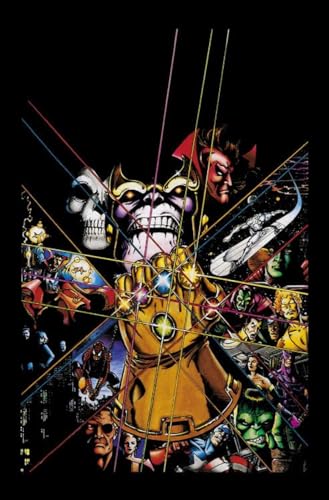
- FactThe Infinity Gauntlet (1991) was written by Jim Starlin with art by George Pérez and Ron Lim, and in it Thanos wipes out half of all life to court the personification of Death.Source: Wikipedia
The abstracts: Eternity, Infinity, Death and Oblivion
Above the Gems sit the abstract entities, who are not characters in the ordinary sense — they are aspects of existence with faces. Eternity is the living universe. Infinity is its spatial counterpart. Death and Oblivion are the negative pair.
These beings do not fight in the way heroes do. Conflicts at that level are usually resolved by jurisdiction: who has standing, whose domain a thing falls under, and whether a higher authority permits it. Marvel's cosmic tier is essentially a courtroom drama at the scale of galaxies.
The Celestials, for all their scale, sit below this tier. They are engineers and judges of species, immensely powerful and physically enormous, but they operate inside the universe rather than embodying it.
- FactEternity is Marvel's embodiment of the universe itself, part of a set of abstract entities that also includes Infinity, Death and Oblivion.Source: Wikipedia
The Living Tribunal and the One Above All
The Living Tribunal is the multiversal judge: a three-faced entity representing equity, vengeance and necessity, whose rulings bind everyone below, abstracts included. Crucially, the Tribunal is the reason the Gems have a hard ceiling — it has ruled that the full set cannot function across universes, which is the in-universe patch that keeps them from ending everything permanently.
Above the Tribunal is the One Above All, Marvel's top-level author-figure, effectively the deity of the Marvel multiverse. It is deliberately barely characterised, and it has been drawn as Jack Kirby, which tells you exactly how the concept is meant to be read.
This is the answer to the eternal fan question of whether the Gauntlet makes you unbeatable. It makes you the most powerful being inside one universe, subject to a court that outranks you.
- FactThe Living Tribunal is a three-faced multiversal arbiter who outranks Marvel's abstract entities, and the One Above All is positioned above the Tribunal as the supreme being of the Marvel multiverse.Source: Wikipedia
The reboots: Iso-Sphere, new Stones, new names
Marvel has reset the Gems more than once. They have been destroyed and reformed as an Iso-Sphere; they were later reintroduced as new stones bonded to new hosts, complete with alternate names and revised effects. In the 2010s and 2020s the Gems were reframed as living things seeking bearers.
The MCU's version — Stones rather than Gems, with fixed rules and no personalities — has since bled backwards into the comics, which is a familiar pattern in modern Marvel.
For a reader, the practical upshot is that Gem lore is era-dependent. Pick a run and its rules are consistent; compare across runs and it is a patchwork.
Where to read it
Start with Infinity Gauntlet, then Infinity War and Infinity Crusade for Starlin's full trilogy. Jonathan Hickman's Infinity is the best modern large-scale version, and his Avengers/New Avengers run is where the multiversal stakes of Gem-level power are most carefully worked out.
If you only read one thing to understand the hierarchy rather than the fights, read a Living Tribunal appearance. Nothing else in Marvel establishes the ceiling so plainly.
Sources
- [1] Wikipedia — Infinity Gems
- [2] Wikipedia — The Infinity Gauntlet
- [3] Wikipedia — Eternity (Marvel Comics)
- [4] Wikipedia — Living Tribunal
- [5] Marvel — Thanos — official character profile